
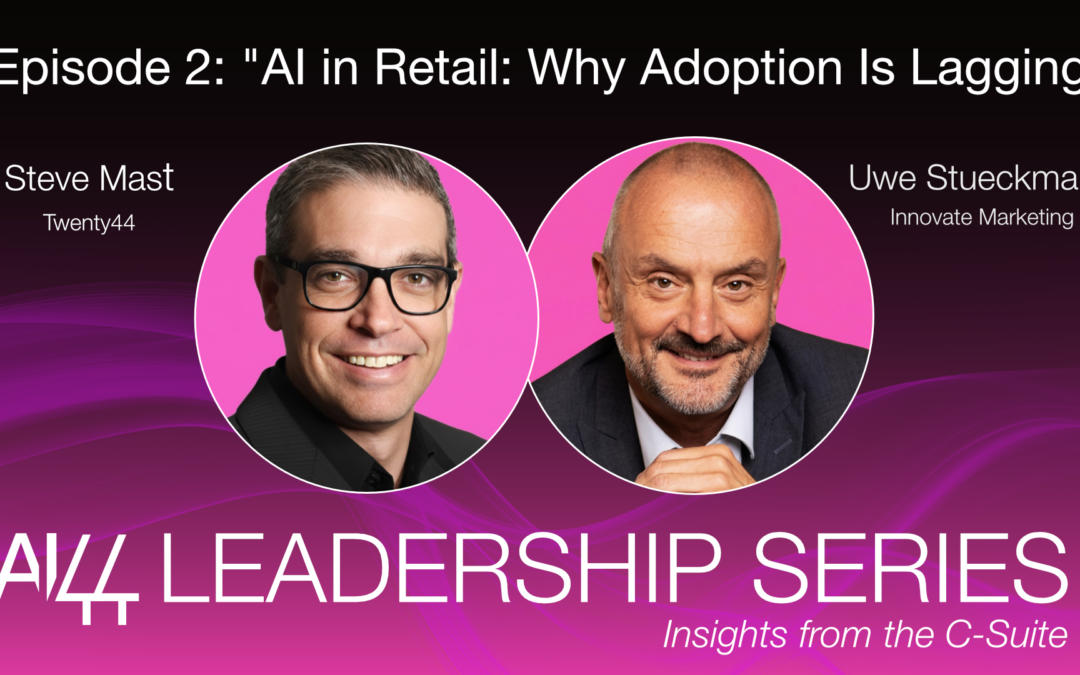
A conversation with Uwe Stueckmann, former EVP & Chief Customer and Marketing Officer at Loblaw, now co-founder of Innovative Marketing.
The Adoption Gap Is Real, And It's Self-Inflicted
Here’s a number worth sitting with: 45% of businesses have paid AI tools, but only 12% of employees use them day-to-day. Meanwhile, those same employees are going home and using ChatGPT to plan birthday parties, book trips, and figure out what to do with a moody teenager.
So what’s happening?
According to Uwe Stueckmann, a lot of organizations got in their own way from the start. “Most organizations lead with what you can’t do,” he says. “Don’t upload your data, don’t use that tool, only use it for these things — and it creates an environment of fear.” That fear breeds hesitation. People start wondering whether they’ll get in trouble for putting a draft contract into an AI tool, so they just… don’t.
The fix isn’t complicated. Lead with possibility, not prohibition. Yes, guardrails matter — but if your first message to employees is a list of restrictions, don’t be surprised when nobody touches the thing.
What AI Actually Looks Like in a Physical Store
A lot of the AI conversation focuses on apps and e-commerce, but the majority of Canadian retail still happens in physical stores. So what does AI actually do for a shopper walking into a grocery store or hardware shop?
Right now, most of the AI work in retail is happening behind the scenes — in inventory management, supply chains, pricing, and assortment planning. The customer experience is subtle: fewer out-of-stocks, marginally better prices as efficiency gains work their way through the system, and shelves that actually reflect what the local neighborhood wants to buy.
That last one is bigger than it sounds. For decades, retailers grouped stores into rough clusters, urban, suburban, near a university, and stocked them accordingly. AI now makes it possible to customize the assortment for each individual store’s trade area. You don’t notice when it works. You just notice that the product you wanted is actually there.
The Small Retailer's Discoverability Problem
The shift is already happening, and most businesses haven’t figured out how to deal with it yet.
People are increasingly using AI tools like Gemini or ChatGPT for product discovery — not just searching, but actually asking for recommendations. Uwe tested this himself: he asked for a gift for his five-year-old niece (pink, Barbies, unicorns, but something different), and the AI came back with great recommendations. Every single one pointed to Walmart or Amazon.
“It’s like water finding the path of least resistance,” he says. “The answer is almost always Walmart and Amazon.”
This is a genuinely serious problem for mid-size and independent retailers. In the old search-engine world, Google gave you 20 links and a local shop might show up somewhere in there. Now you get one or two recommendations, and if you’re not a dominant player with tons of product data and visibility, you’re invisible. The long tail that Shopify helped create is quietly being squeezed back.
The moves available to smaller retailers: invest in richer product data, make your inventory discoverable without requiring a login, and find niches where you can genuinely differentiate.
Who Should Own AI Inside a Company? (Hint: Not Legal)
One of the more practical parts of the conversation was about governance, who’s actually responsible for AI inside an organization, and how should that work?
Uwe’s view: don’t put it in legal, finance, or IT if you want innovation. Those functions are naturally wired to protect, not explore. The typical pattern of standing up a task force to report back to the board sounds organized but tends to slow everything down without actually driving change.
His preferred model is a federated one, each team owns their AI tools and use cases, with the freedom to move, guided by sensible guardrails and connected through a cross-functional community of practice. Think of how the best organizations handle analytics: teams have their own analysts who also share tools, training, and career paths through a common structure. AI governance could work the same way.
If you need someone to run it, look to your CDO or a corporate strategy function. Someone whose job is to find opportunity, not avoid risk.
If You Can't Measure It, Don't Do It
A thread running through the whole conversation: vague AI initiatives die quietly. Handing 100 people a Copilot licence and hoping something interesting happens isn’t a strategy, it creates resentment and produces nothing you can point to.
What actually works is picking a specific problem, setting a clear goal with real numbers attached, and measuring progress against it. Uwe’s example from his time at Parkland: a supply chain optimization project with a defined earnings target. When it hit, everyone wanted more. That’s how you build internal momentum.
What Leaders Actually Need to Do
Three things, in plain terms:
Get curious, not expert. Take a course or two, not to become a technical wizard, but to get smart enough to ask the right questions and know when you’re being told something that doesn’t add up.
Protect critical thinking. In a world where AI can generate a confident-sounding answer to almost anything, the skill that matters most is knowing when to push back. Uwe built an internal curriculum at his last company called “The Power of Critical Thinking” for exactly this reason.
Don’t fight it. The employees most at risk aren’t the ones learning to work with AI, they’re the ones trying to block it. The better move is to use this moment to pick up new skills and become part of what’s coming, not a casualty of it.
As Uwe puts it: the shift to AI is going to be bigger than the internet, bigger than the smartphone. If we use it well, there’s a genuinely great future on the other side of it.
Transcribed by Microsoft Teams, summary and outline by Claude Sonnet.

Randy Matheson
Randy Matheson is an innovation strategist with a 25+ year proven track record of turning ideas into digital products. He specializes in working with Generative AI for content creation and using cutting-edge AI tools to create and interact with virtual audiences. He operates out Hamilton, Ontario where he resides with his partner and two large dogs.