
Where does your team really stand with AI? Stop guessing. Start knowing.
AI/44 assessments show where you really stand: your workforce’s skills and judgment, and your organization’s strategy, data, systems and governance. AIcademy44 closes the skill gaps. Our advisory team and partners deliver the rest of the roadmap. The AI/44 Index shows how you compare.








How ready are your people? And how ready do they think you are?
The AI/44 Workforce Assessment scores both: how ready your people are, and how ready they think your company is. It benchmarks every number against thousands of records in the AI/44 Index, so you can see where you're ahead, where you're behind, and where to act first.
See a sample report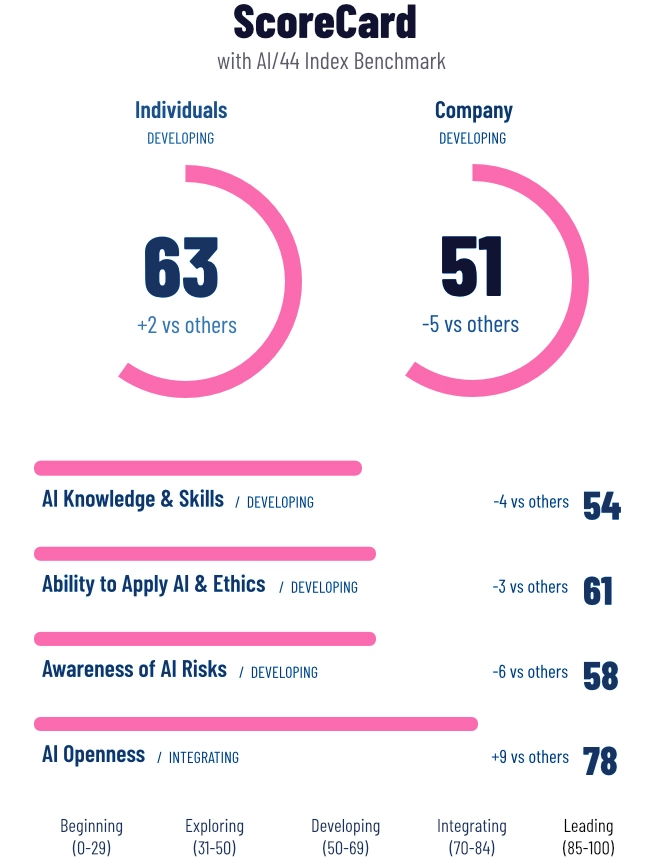
View one:your people.
Every person is measured on four pillars: mindset, skills, application and judgment.
The diagnostic grew out of our own research into what drives AI adoption, and what blocks it. These four pillars are what made the difference.
We don’t just ask nicely. We test.
Most AI assessments ask people to rate themselves. The problem is that confidence and capability aren’t the same thing. People who feel ready often aren’t, and people who doubt themselves are often further along than they think.
So we ask about attitudes and usage, then we test the two skills that matter most. Each person writes a real prompt, scored live by AI using our proprietary scoring rubric. Then they work through real business scenarios that test their judgment: when to trust an AI answer, and when to check it.
The advantage: you train people on the skills they actually lack, not the ones they say they lack. And when you re-test, you see real progress, not a change in confidence.
91% of people know a vague prompt needs rewriting. Their average prompt test score: 5.2 out of 10.
Together, these four pillars make up your workforce’s Individual AI Readiness score.
View two:your company.
The same people then tell us how ready they think your company is. It’s not an audit of your org chart. It’s whether the plan, the rules and the training are actually reaching them.
Across the AI/44 Index, only 1 in 4 employees say leadership has communicated a clear AI plan.
Your people can tell you whether the plan is clear. Whether it’s the right plan is what we work out with your leadership team, and that work becomes the backbone of your roadmap.
Together, these five areas make up your Company AI Readiness score.
Two views.One diagnosis.
Both views feed the diagnosis. Where Individual AI Readiness and Company AI Readiness land against each other tells you which problem you have, and which fix it needs. That diagnosis becomes your roadmap.
Training won’t fix a policy problem. A policy won’t fix a skills problem.
Strong org, people behind
Build Skills
The plan, policy and tools are in place. The capability to use them isn’t.
Both strong
Accelerate
Foundations are solid. Move to workflow redesign and scale.
Both weak
Foundational Reset
Start with literacy and a clear, communicated plan.
People ahead, org behind
Fix the Org
Your people are ahead of your policy, and working outside the guardrails.
Both weak
Foundational Reset
Start with literacy and a clear, communicated plan.
Strong org, people behind
Build Skills
The plan, policy and tools are in place. The capability to use them isn’t.
People ahead, org behind
Fix the Org
Your people are ahead of your policy, and working outside the guardrails.
Both strong
Accelerate
Foundations are solid. Move to workflow redesign and scale.
Your diagnosis becomes your roadmap.
Where you start depends on your diagnosis.
Each quadrant points to a different first move. If your people are ahead of your policy, we start with governance and communication. If the company is ready but skills are behind, we start with training. If both are strong, we go straight to workflow redesign. If both are weak, we build the foundations first.
From there, the pillar scores and team-level results shape the details, so your roadmap is built around your results, not a template.
1 · Plan
Build the roadmap
We turn both views into a 12-month plan with a detailed first 90 days, worked through with your leadership team. What to fix first, who to train on what, which tools to license. Not another slide about becoming “AI-first.”
2 · Act
Do it with you
No plan survives without execution. We hold workshops to help prepare the culture, redesign your highest-value workflows, and close the skill gaps the assessment found with personalized modules in AIcademy44.
3 · Re-measure
Prove it worked
Repeat the assessment, track every person and team from one assessment to the next, and see whether your investment actually moved the score.
Close the skill gaps.Faster with AIcademy44.
The roadmap says who needs what. AIcademy44 delivers it. Assessment results put each person in the right course, so nobody sits through training that’s too basic or too advanced.
In the initial AIcademy44 rollout, prompting skill scores rose from 49 to 77 (out of 100), and the share of people confident using AI for real work went from 40% to 74%.
Live AI feedback
Every prompt is scored, with the one fix that matters most.
Built for practice
Realistic tasks from learners daily work, not passive videos.
Mastery-based
People move on when they’ve shown the skill, not when the clock runs out.
Ready to be put to use
Prompt and agent templates they keep after the course.
Reporting
Track every learner’s progress, attempts and scores, so you can see who’s moving and who needs help.
Generative AI 101
Start here. What generative AI is, where it came from, and what it can and can’t do.
AI at Work: From Prompting to Practice
Our flagship module. Build the skills to use AI effectively at work: how prompts work, how to get better results, how to spot when AI gets things wrong, and how to find real opportunities in your own role. Starts with a pre-assessment and ends with a post-assessment, so you can see the lift.
More modules, applied tracks by role, and how it connects to your assessment.
Find out where your
team really stands.
Tell us what you’re trying to do with AI. We’ll show you what AI/44 would measure, and what it usually finds.